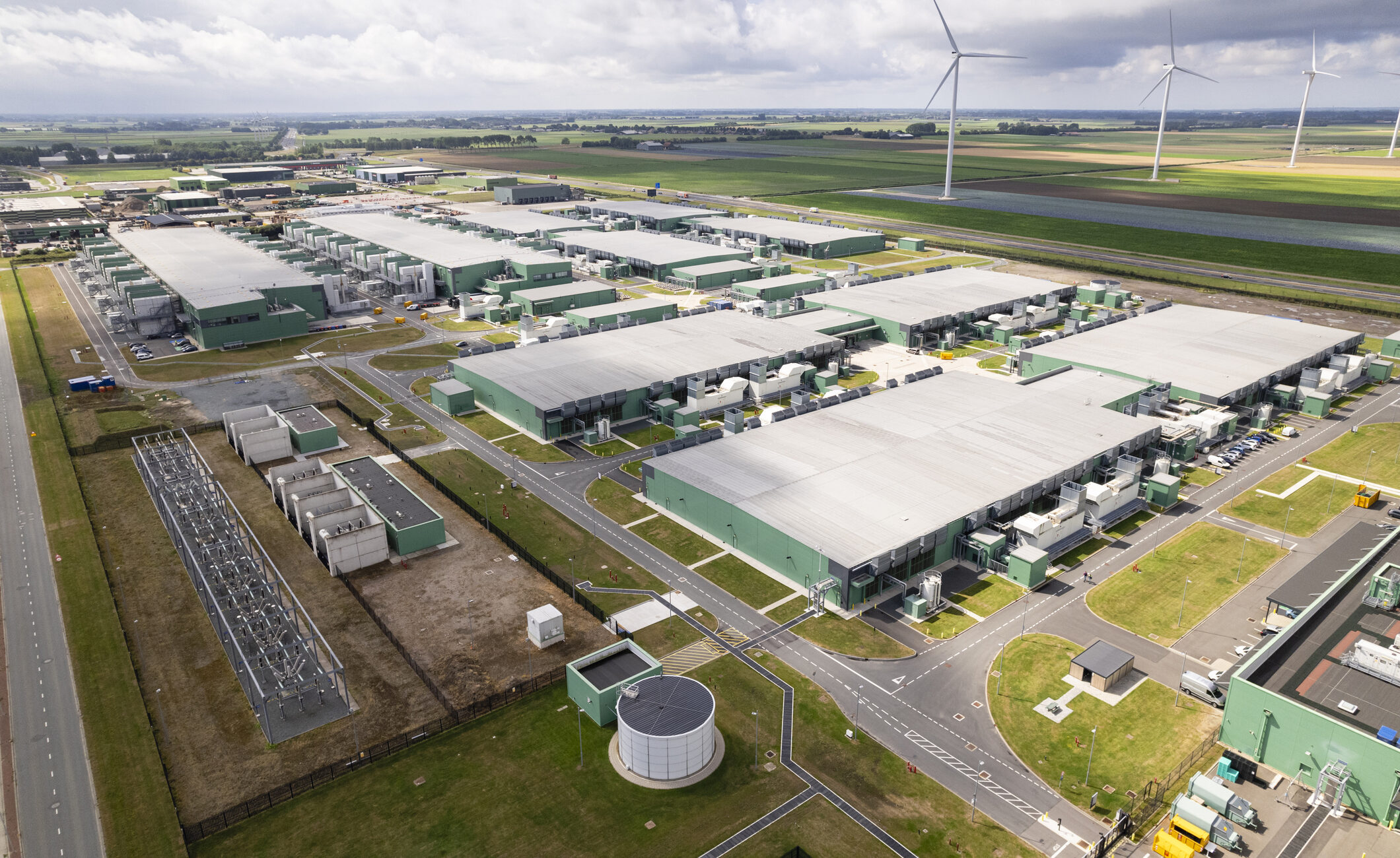


Data centres have become part of the fabric of modern life. Every online payment, hospital record, video call and AI query passes through one. As Europe builds out its artificial intelligence capabilities and deepens its digital economy, these facilities are quickly becoming as fundamental to European competitiveness as ports, railways and power stations.
The European Commission has recognised as much and has proposed a Cloud and AI Development Act that aims to at least triple the EU’s data centre capacity within the next five to seven years. [1] The build-out is already underway. European data centre IT power capacity has grown by around 40% in just two years, reaching almost 14,800 MW in 2025, and demand is forecast to continue growing at double-digit rates into the next decade. [2] Electricity consumed by EU data centres is projected to rise from 68 TWh in 2024 to 114 TWh in 2030, by which point it would account for over 3% of EU electricity demand. [3] Given their central role in critical economic and social infrastructure, the issue is not simply the volume of electricity these facilities require. It is also the need for an uninterrupted, resilient and reliable power supply.
What resilience really means
A data centre is expected to run around the clock, every day of the year, and the digital economy is built on that assumption. Yet no electricity grid is perfect, and as networks absorb rising volumes of variable renewable generation and connect ever-larger consumers of electricity, including data centres themselves, the moments of stress will not disappear.
For this reason, in the basement of nearly every data centre in Europe, between the grid and the servers, sits an uninterruptible power supply (UPS), a bank of batteries and power electronics that carries the full electrical load of the facility the instant mains power fails. The batteries typically need to hold that load for only five to fifteen minutes, long enough for on-site generators to start and take over. They may be called upon only a handful of times in their service life, but when they are needed they must be available and function without fail, so that those same payments, records, calls and queries keep flowing. EU law reflects the centrality of this equipment, and the Union’s data centre reporting rules use the UPS as the reference point at which a facility’s IT energy consumption is measured. [4]
The demands on these systems are also changing, as data centres now run three broad types of workload. Conventional computing, such as email, websites and business software, draws power fairly steadily, so its UPS serves mainly as a reserve. AI inference, which runs AI models to answer queries, and AI training, which builds them, draw far more power per rack of servers. AI training in particular can swing sharply, with sudden spikes and equally sudden drops that strain on-site equipment and the grid. [5] Batteries are therefore increasingly expected to help steady the supply as well as cover outages.
Where lead batteries come in
Several battery technologies are used in UPS systems today, but lead batteries have performed this duty in critical facilities for decades and remain one of the most widely installed choices. A UPS battery spends almost its entire life held at full charge and must then deliver a short burst of very high power on the rare occasion the grid fails. Lead batteries handle this profile reliably, at low initial cost, with maintenance practices that operators understand well and an operational track record few technologies can match.
The difference between these workloads matters for battery choice. “The growth of data centres is not uniform; AI training, AI inference and other non-AI applications can come with distinct workload profiles in which power can behave differently,” observes Dr. Thomas Verghese, Business Development Manager (Industrial and Systems) at EnerSys, a global manufacturer of industrial and reserve power batteries. “Lead-based battery technologies continue to play a key role across various data centre applications, especially where reserve power is the primary function of onsite batteries.”
The largest new AI sites mostly use lithium-ion batteries, but the wider picture is different, particularly in Europe. In Europe, lithium accounts for only around 20 to 30% of new data centre UPS installations. Businesses, public authorities, healthcare and financial services, and many shared facilities that rent space to multiple customers, still prefer lead. Lead’s position is strongest in conventional computing, which is expected to remain a significant share of data centre IT infrastructure worldwide into the 2030s. [6]
Lead battery technology has not stood still. Modern designs, including thin plate pure lead batteries engineered for high-rate discharge, offer longer service life and smaller footprints than earlier generations, and European manufacturers have brought new ranges to market aimed specifically at data centre applications. Demand for reserve power batteries is expected to grow alongside the data centre build-out, and stationary applications are among the fastest-growing segments of the lead battery market. [7]
Furthermore, as Europe’s electricity system moves towards greater flexibility, pilot projects in Ireland, Sweden and Norway have used lead-based UPS systems to provide fast frequency response services to the grid, helping to steady the system at moments of stress while preserving their role as emergency reserve. [8]
A digital future on secure foundations
For decades, lead batteries have provided the immediate, high-power reserve on which data centres depend during an interruption to mains supply. They remain well suited to this role, combining proven reliability, strong high-rate performance and established operational practice.
They also offer a supply-chain advantage that is increasingly important. While much of the digital value chain relies on materials, components and manufacturing capacity beyond Europe’s control, lead is supported by a well-established, highly circular, and largely European-based supply chain. More than 75% of Europe’s lead already comes from recycled sources. [9] The average lead battery contains more than 80% recycled content [10], and more than 90% of a used lead battery can be recycled to produce battery-grade materials [11]. Batteries used to protect Europe’s data infrastructure can therefore be manufactured, collected, and recycled sustainably within the Union.
As European data centre capacity grows, resilience must be considered in the round, covering reliable power, reliable backup and reliable access to the materials that make that backup possible. Maintaining access to lead materials and lead-based battery technologies should form part of a wider strategy to ensure that Europe’s digital expansion rests on resilient foundations.